
Under the Mining Law of 1872 (the “Mining Law”)[2] lode claimants may, in certain circumstances, follow a vein’s downward course beneath neighboring claims.[3] This is known as the “Apex Rule” (herein, the “Rule”) and the rights it bestows upon a claimant are powerful since it (i) entitles miners to extract minerals that stray onto adjoining claims or other public land (and in some cases onto patented mining claims) that the miner does not own and (ii) provides a potential avenue to invalidate a rival claimant’s adjoining locations. However, the Rule’s applicability is also very narrow since many currently exploited and newly discovered deposits are widely diffused and lack an apex, and proving that extralateral rights exist—or have been violated—is a highly fact-dependent and technical exercise, making it costly to litigate disputes arising under the Rule.
What are Extralateral Rights and the Apex Rule?
At its most basic, the Apex Rule provides the holder of a valid lode claim with “extralateral rights” if the uppermost edge or point of the mineral vein (known as the “apex”) is located within his claim (whether at or below the surface). These extralateral rights then generally permit the miner to follow the vein onto all mining lands, whether unpatented or patented (including land previously located by others under the Mining Law) outside of his claim’s borders.[4] These extralateral rights are “purely statutory”—there is no supporting common law—and may also be referred to as the “right of lateral pursuit.”[5]
Establishing Extralateral Rights
The party claiming extralateral rights has the burden of proof to establish certain required elements, which typically requires having or developing extensive geological information about the claim(s) from which the claiming party argues the extralateral rights flow, as well as with respect to the adjacent claims:
- Valid Lode Location: The claim must be a properly located lode mining claim (extralateral rights do not attach to placer, mill site, or tunnel site claims), patented or unpatented.[6]
- Apex Within Claim Boundaries: The vein must have an apex that lies within the claim. While limited “legal/judicial apex” doctrines exist, they provide limited exceptions to this requirement.[7]
- Downward Course (Dip) Into Certain Categories of Adjacent Lands: The vein must dip downward from the apex (i.e., there are no extralateral rights in a horizontal vein because it has no downward course) into land not previously appropriated or patented as non-mining land and not conflict with a prior apex right.[8]
- Continuity of Vein: The vein must be continuous between the apex and the portion of the vein being pursued extralaterally; since veins frequently twist and turn, continuity can be difficult to prove without detailed mapping, drilling, expert analysis, and sometimes workings along the vein.[9]
- Parallel End Lines: Since a vein cannot be pursued on its strike beyond the ends of its location (i.e., it can only be pursued beyond the side lines—not the end lines, see Diagrams 1 and 2 below), generally, the claim must have parallel end lines defining the lateral limits of the extralateral right; courts may recharacterize lines for the discovery vein, but parallelism still governs.[10]
The Practical Limits of the Apex Rule
- Surface Use Not Included. Extralateral rights do not authorize entry on a neighboring property; any underground pursuit of the vein must originate from workings within your own surface estate or be obtained by separate access rights under applicable state law.[11]
- Geological Realities Can Be Limiting. Because the extent of a claimant’s right to exercise his extralateral rights is limited to the length of the apex that lies within his claim, factors such as the location of the vein within the location, the length of the apex, and the point of entry and exit of the vein within the location can operate to limit a claimant’s extralateral rights.[12]
- Deposit Type Matters. “Blanket veins” or broadly horizontal mineralized zones typically do not have a qualifying apex and therefore do not support extralateral rights.[13]
- Modern Mining Realities. The Mining Law was enacted at a time when the only known method of locating lode deposits was by surface, visual geological observation. Because early miners did not recognize at that time that veins could be susceptible to folding or faulting or that several apexes might represent one vein, it was logical that surface discoveries would form the basis for locating claims. Notably, the United States is the only mining jurisdiction that still adheres to the rule and modern courts and commentators have questioned the rule’s fit with geological reality as now understood as well as modern mining methods.[14]
- High Burden / Lack of Modern Precedent. The burden of proof on establishing extralateral rights (and the extent thereof) lies with the extralateral claimant. Courts have not established a uniform evidentiary standard, but the burden is typically “substantial”—requiring things such as geological mapping, expert opinion, and drilling results. Further, Apex Rule litigation has been very uncommon since the first part of the 21st century as modern operators instead frequently seek to avoid such costly, fact-intensive, and uncertain litigation by negotiating joint development or boundary agreements or purchasing adjacent claims.[15]
Competitive Positioning and Inter-Claim Conflict Considerations
- The Role of Seniority. The exercise of extralateral rights does not depend upon seniority. However, when two or more veins intersect, the senior locator takes the ore within the space of intersection, while junior claimants retain rights to their claim and a right of way for convenient working. And when two veins unite, the older or prior location takes the combined vein below the point of union, including all forks and splits below that junction.[16]
- Challenging Junior Locations. Historic Interior Department decisions support arguments that a junior claimant’s location based solely on a vein already validly appropriated (i.e., based on a vein whose apex lies within a senior locator’s claim) may be invalid for lack of discovery. While context-specific, this line of authority remains cited.[17]
Action Items for Claimants Seeking to Exercise Extralateral Rights
- Assess the Deposit. Confirm whether your mineralization is a true lode or vein with an apex (versus a blanket-style deposit), which is often dispositive for extralateral analysis.
- Map the Apex and End Lines with Precision. Delineate the apex’s location, length, width, and the claim’s end-line geometry to understand the true scope of any extralateral right.
- Build the Geological Record. Collect geologic evidence to support vein type, continuity, and path (e.g., geologic mapping, oriented drilling, structural interpretation).
- Plan Access. If extralateral pursuit is feasible, secure underground access from your surface estate or obtain easements/rights-of-way under state law.
- Consider Commercial Solutions. Given the cost, uncertainty, and fact intensity involved in an Apex Rule dispute, consider mitigating risk through boundary agreements, joint development agreements, or strategic acquisitions instead of litigation.
Bottom Line
Diagram 1: Side Lines, End Lines, the Apex, the Dip, and “Lateral Pursuit”[18]
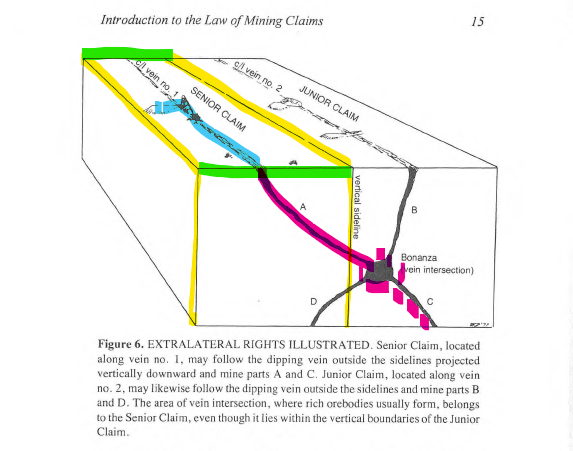
DIAGRAM KEY:
- The side lines of a claim (yellow highlight) cannot exceed 1500 feet. In an ideal location, the side line should parallel the vein as closely as possible to maximize the extent of the lode included within the boundaries of a claim.
- The end lines (green highlight) of a claim cannot exceed 600 feet. Extralateral rights do not extend beyond the end lines.
- The “apex” of a vein, lode, or ledge is the top or highest point of the vein proper, whether at or below the surface and the terminal edge from which the vein extends downward to form a dip (blue highlight).
- Extralateral rights, or the “right to lateral pursuit” entitle a senior claimant to follow the dipping vein (pink highlight). The area of vein intersection or “bonanza” belongs to the senior claimant, and he may continue to follow the vein originating at his apex beyond the intersection (dotted pink) to the maximum length permitted.
Diagram 2: The Strike and Dip of the Vein[19]
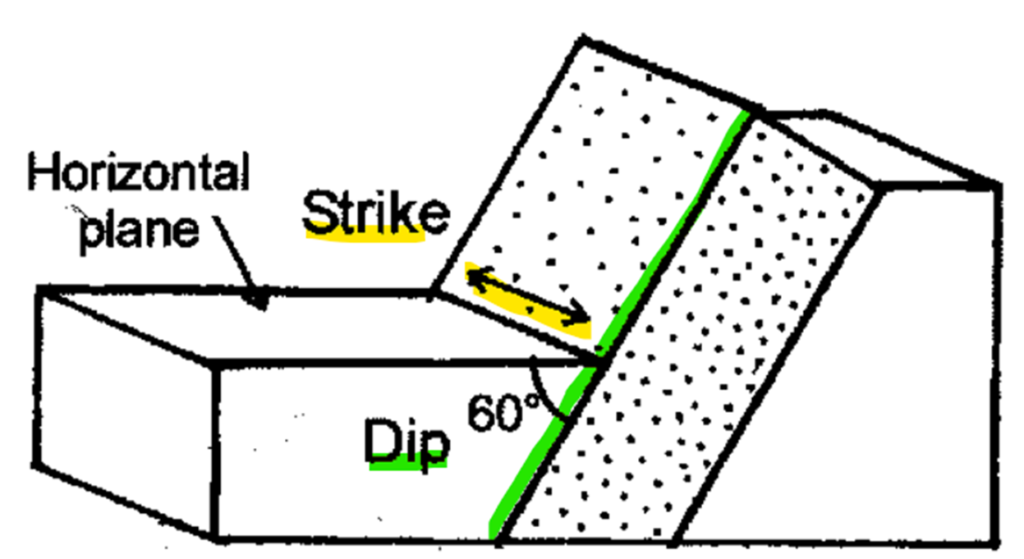
DIAGRAM KEY:
- The “strike” of a vein is its horizontal course (yellow highlight).
- The “dip” is the downward course of the vein at a right angle to the strike (green highlight).
[1] As indicated by the footnotes that follow, we have relied heavily on the American Law of Mining, published jointly by the Foundation for Natural Resources Law and Matthew Bender—an invaluable resource for information on the Mining Law of 1872—for this analysis.
[2] 30 U.S.C. § 26.
[3] Am. Law of Mining, 2d Ed. § 37.01[1]; Silver Surprize v. Sunshine Mining Co., 15 Wash. App. 1, 6, 547 P.2d 1240, 1244 (1976).
[4] See 30 U.S.C. § 26 (providing that a lode locator “shall have the exclusive right of possession and enjoyment of all veins, lodes, and ledges throughout their entire depth, the top or apex of which lies inside of such surface lines extended downward vertically, although such veins . . . may so far depart from a perpendicular in their course downward as to extend outside the vertical side lines of such surface locations.”); supra, note 2, §§ 37.02[5], 37.05[1].
[5] Supra, note 2, § 37.01[1] n.1, [3].
[6] Supra, note 2,§ 37.02[1].
[7] Supra, note 2, §§ 37.01[4], 37.02[2].
[8] Supra, note 2, § 37.02[5].
[9] Supra, note 2, §§ 37.02[3]; 37.02[5], 37.01[2]; Silver Surprize, 15 Wash. App. at 8, 547 P.2d at 1246.
[10] Supra, note 2, §§ 37.02[4], 37.03[2].
[11] See 30 U.S.C. § 26 (Nothing in this section shall authorize the locator or possessor of a vein or lode which extends in its downward course beyond the vertical lines of his claim to enter upon the surface of a claim owned or possessed by another); supra, note 2, § 37.01[3].
[12] Supra, note 2,§ 37.02[1].
[13] Supra, note 2, § 37.01[4]. As noted in the introduction, the Apex Rule would not apply to a number of currently mined and recently discovered deposits, including in-situ uranium, lithium brine, and diffuse gold and silver, because these are broadly mineralized rather than vein- or lode-style deposits. Further, even if a mineral deposit meets the definition of a “vein” or “lode” under 30 U.S.C. § 26 (i.e., a mineral body within defined boundaries), it may not have an apex, in which case extralateral rights do not attach.
[14] Robert Leclerc, Perspectives Du Nord: A Canadian View of Problems and Opportunities in International Business Transactions, 32 Rocky Mtn. Min. L. Inst. 6 (1986), 6-6; Harry Macdonell, Comparative Analysis of American and Canadian Hard Mineral Laws, 10 Rocky Mtn. Min. L. Inst. 13 (1965), 439; Silver Surprize, 15 Wash. App. at 16, 547 P.2d at 1250 (“Modern mining practice seems to require amendment of the act of 1872 to deal specifically with the problems that arise from deep underground discoveries.”).
[15] See Supra, note 3,.
[16] Supra, note 3, § 37.05[3].
[17] M-36955, “Apex and Extralateral Rights Issues Raised by the Stillwater Mineral Patent,” 93 Interior Dec. 369, 382, 1986 I.D. LEXIS 34, *34; Bunker Hill & Co. v. Shoshone Mining Co., 1904 I.D. LEXIS 157, *9, 1904 I.D. LEXIS 157 (1904); Golden Link Mining, Leasing & Bonding Co., 1899 I.D. LEXIS 78, *5, 1899 I.D. LEXIS 78 (1899).
[18] Diagram taken from the Digest of Mining Claim Laws (Fifth Edition, 1996), published by the Rocky Mountain Mineral Law Foundation (now known as the Foundation for Natural Resources and Energy Law).
[19] Diagram taken from Research Gate, https://www.researchgate.net/figure/Diagram-illustrating-strike-and-dip-After-you-cross-the-bridge-walk-east-to-your-left_fig10_239604084.